Clinical audits and QIPs,
without the lost weekend.
The heartbeat of better care
Barihan turns a policy or a national standard into the whole audit: measurable, source-backed criteria, a data collection sheet and cheat sheet, results and recommendations, and a QIP plan you can actually run. Built for the NHS doctors and clinicians who do them.
Free plan available · No patient identifiers
Illustrative example. Not real patient data.
Built on the standards your audit will be judged against
Audit shouldn't cost you your weekend.
The clinical thinking takes an hour. The method takes the rest of the weekend. Barihan removes the method, not the medicine.
Method eats the medicine
Hours go to finding the standard, writing measurable criteria and building the spreadsheet, before a single patient is reviewed.
Generic, not your trust
Templates that don't reflect your local policy, the national guidance, or the patient in front of you.
Deadlines beat the data
ARCP, QIP and governance dates arrive faster than the evidence, and re-audit is the first thing to slip.
From policy to audit-ready in one sitting.
Everything an NHS audit or QIP needs, generated, source-backed and portfolio-ready.
Know where to start
From a topic or your own policy, you get the aims and measurable criteria: the blueprint that usually takes the longest.
The data sheet does the heavy lifting
A ready data collection sheet, plus a cheat sheet for where each data point lives. Clinicians told us this is the part that eats the most time.
Source-backed to the standard
Every criterion cited to NICE, HQIP or a Royal College, with a target and exceptions. Defensible at governance.
A QIP plan you can run
A real plan: aim, change ideas, PDSA, measurement and re-audit, tracked on a dashboard over the months that follow.
From zero to submitted, in five steps.
The same workflow every time, for every audit type.
Choose your topic
100 ready-made NICE-aligned topics, or build your own from a local policy.
Get source-backed criteria
Measurable criteria with targets, exceptions and the cited standard behind each.
Collect your data
A data collection sheet, plus a cheat sheet showing where to find each point.
Enter your results
Type them in or upload the sheet. No formulas, no manual maths.
Get your pack
Results and recommendations, a QIP plan, poster, slides and ARCP evidence. The dashboard tracks the cycle and prompts the re-audit.
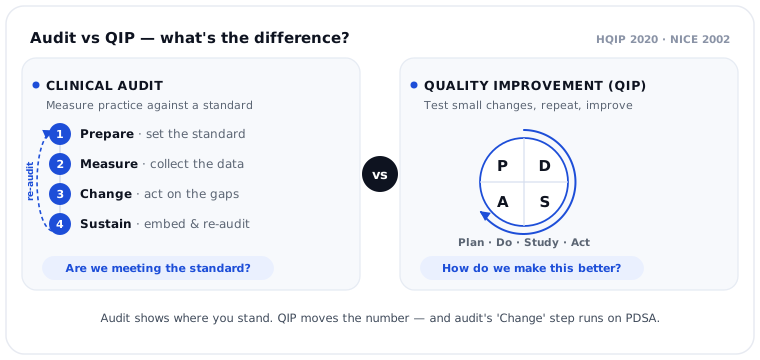
Audit vs QIP — what's the difference?
Two tools nearly every clinical team has to use — doctors, nurses, ACPs, PAs and pharmacists alike. Here's the plain-English difference, grounded in HQIP and NICE.
Clinical audit
Measures current care against an agreed, evidence-based standard, then acts to close the gap and re-audits to prove it improved. The question: are we meeting the standard?
Quality improvement (QIP)
Broader and iterative: you test small changes in repeated PDSA cycles — Plan, Do, Study, Act — to make a process or outcome better. The question: how do we make this better?
They aren't rivals. Audit tells you where you stand; a QIP is how you move the number — and audit's own "change" step runs on PDSA. One sits inside the other.
Grounded in HQIP, Best Practice in Clinical Audit (2020) · NICE/NCCA, Principles for Best Practice in Clinical Audit (2002) · University Hospitals Bristol guidance.
Built from inside the NHS audit workload.
Every audit I've done started the same way: a blank page and a quiet dread. Where do I begin? What's the question? How do I build the dataset, run the analysis, write it up — and then rebuild the whole thing again for my portfolio?
It was draining. Hours none of us have, spent on something that too often felt like a box to tick rather than care actually made better.
So I built the tool I wish I'd had.
The name says what it's for. Barihan means the heartbeat of life — and with it, a sense of peace, and ease. That's the feeling this should give you: knowing where to start, trusting that it can be done — and done properly. Quickly. Precisely.
It never does the thinking for you. The clinical judgement, and the final review, always stay with you.
Because when the hard part gets easier, we do more of it. And every audit done well is patient care, lifted a little higher.
A clearer path from clinical question to completed audit.
Are we meeting the standard?
Good audit starts with a question that matters, and Barihan is built around that one. It gives clinicians structure through the whole process: define the topic, review the standard, collect the data, understand the results, generate QIP actions, and produce outputs that can be reviewed, shared and evidenced.
The aim isn't to make audit automatic or superficial. It's to make credible audit work easier to complete well.
- So trainees build stronger portfolio evidence.
- So consultants produce clearer revalidation outputs.
- So audit leads and governance teams review more consistent work.
- And so more clinical questions reach the point where the findings can actually be used.
Tested with NHS doctors and clinicians.
Straightforward pricing.
Start free · monthly or annual billing · Enterprise is contact sales.
Your next audit, without the weekend.
No card needed. Start with your first audit free.